Ponticello’s tuner, for every string

Every string,
in tune.

Pontifork tunes the cello, the guitar with six or seven strings and the bass with four, five or six — in every standard, drop, open and lowered tuning players actually use, with a chord book that follows your tuning. Open it in any browser or install the app. No account, and nothing leaves your device.

  • 53tunings, from drop A to open G
  • ±5¢counts as in tune
  • 120chords, in any of them
Tuning a guitar from the low E up, recorded from the web app.
The Pontifork icon: a maple tuning fork ringing out four coloured sound waves on an indigo ground.

The mark

A tuning fork, with Ponticello’s heart

Pontifork is ponticello — Italian for “little bridge” — and a tuning fork. The mark is the fork in the bridge’s bleached maple, with the bridge’s round heart cut through its knob, ringing out four waves in the colours of the four strings: C green, G red, D blue, A yellow, left to right. On iOS the fork and the waves are separate Liquid Glass layers, drawn in Icon Composer the same way as Ponticello’s.

One engine, three instruments

From a bass’s low B to a guitar’s high E

Cello, guitar and bass

The pitch engine that never mistakes a low C

Pontifork listens with Ponticello’s dual-rate engine, built for an instrument whose lowest note the body barely radiates — and widened to reach a five-string bass in drop A at 27.5 Hz and a guitar’s twelfth fret. It judges octaves by the period, not the loudest harmonic, so a low string is never read an octave up and a high one never an octave down.
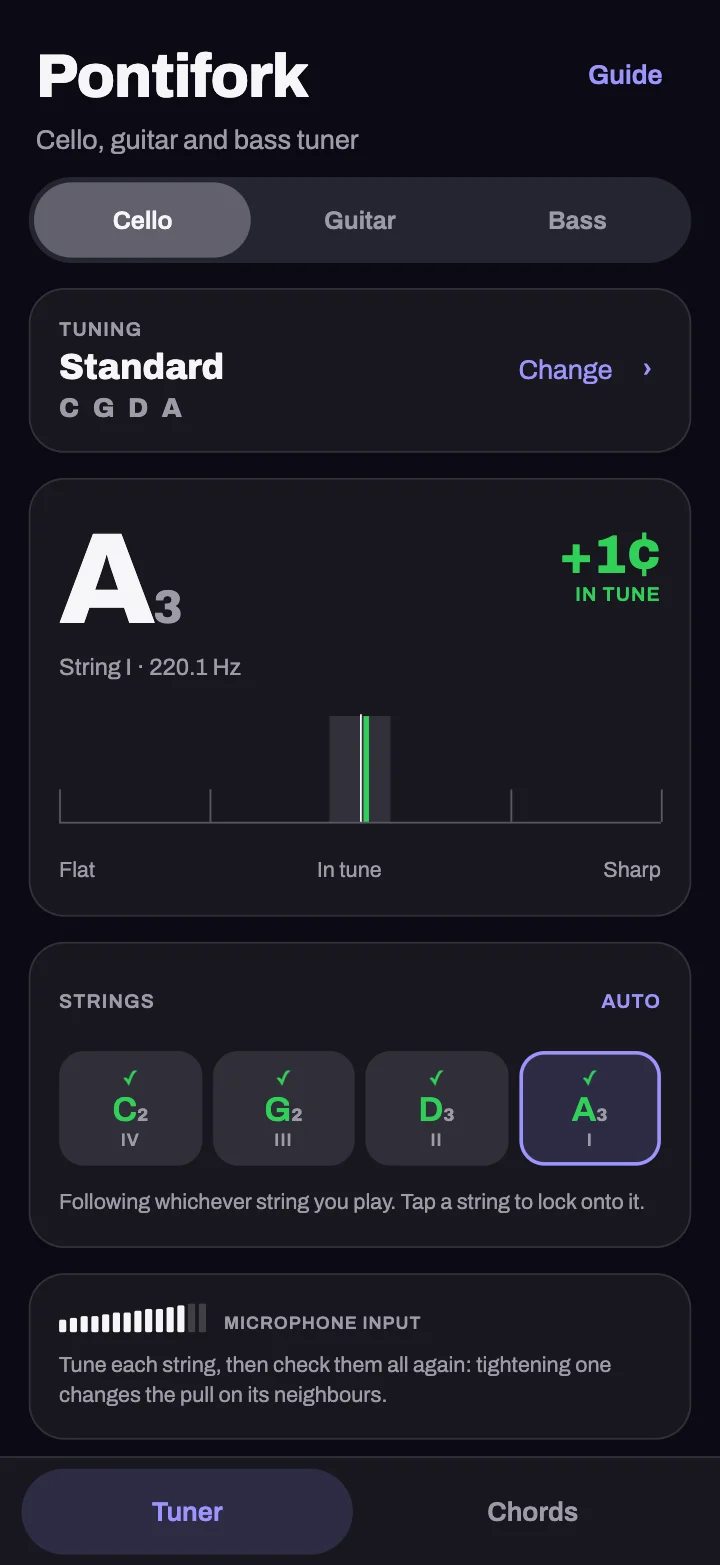
Cello in the dark theme: the A string in tune at plus one cent, and all four strings ticked.
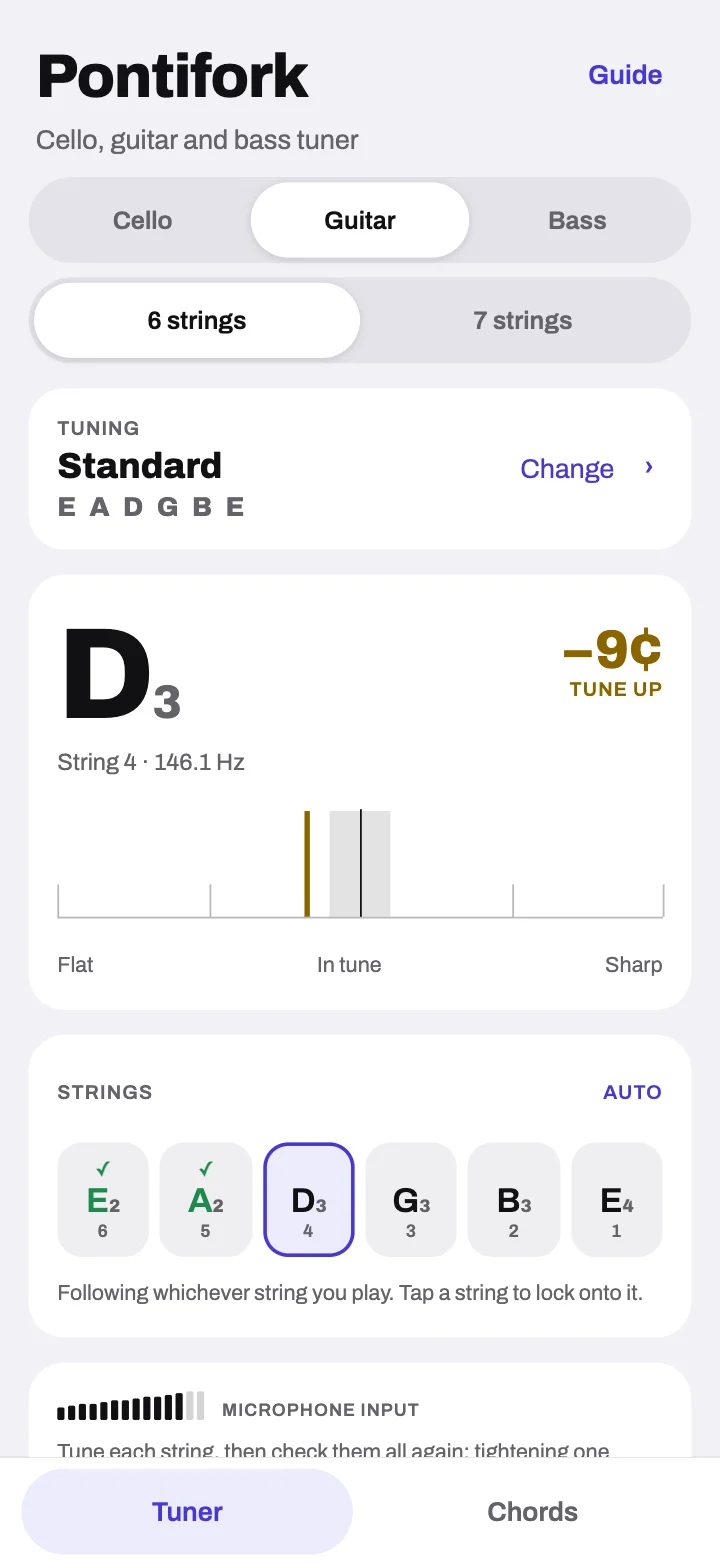
Guitar in standard tuning: the D string nine cents flat with the needle left of centre and Tune up in amber; the two lower strings ticked.
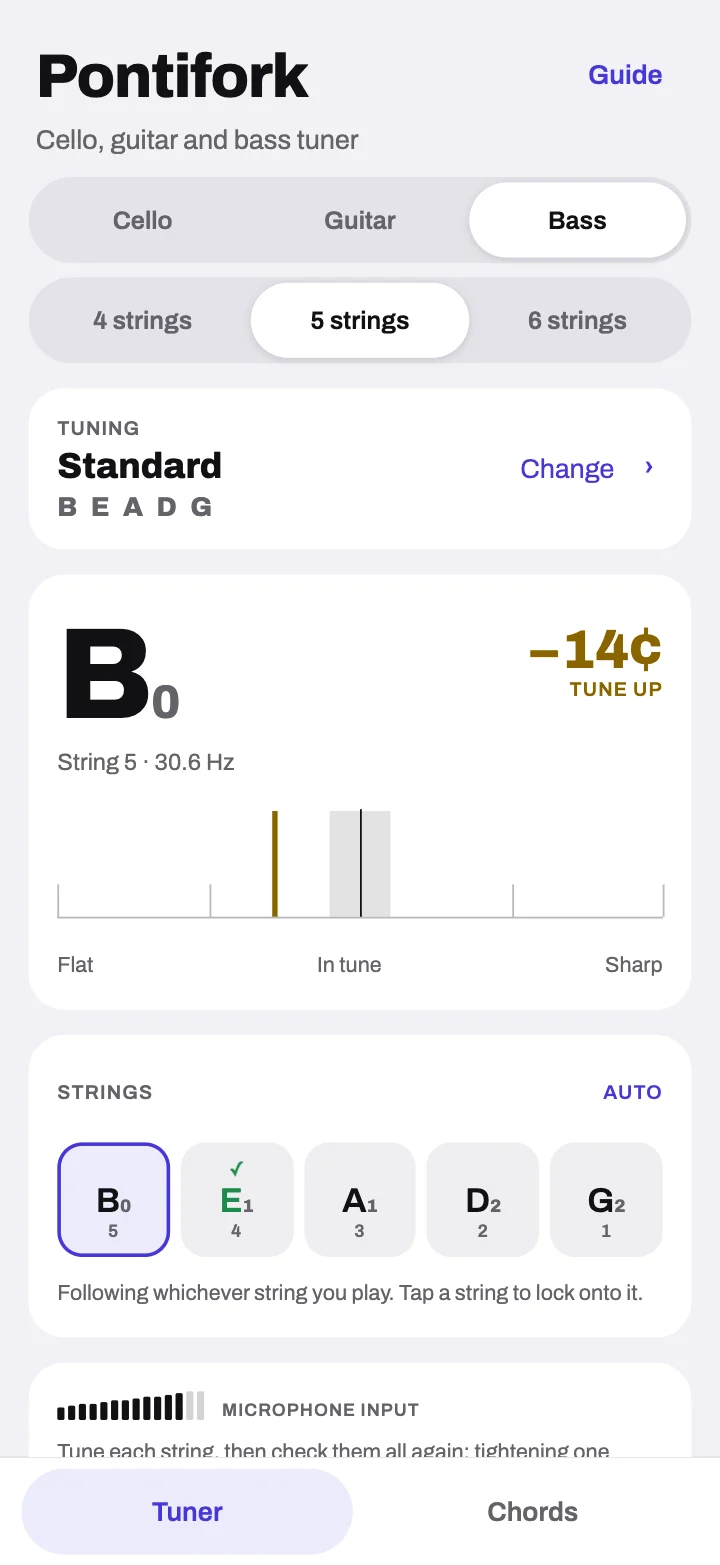
Five-string bass: the low B fourteen cents flat, Tune up.

Measured against the string

It knows which string you are tuning

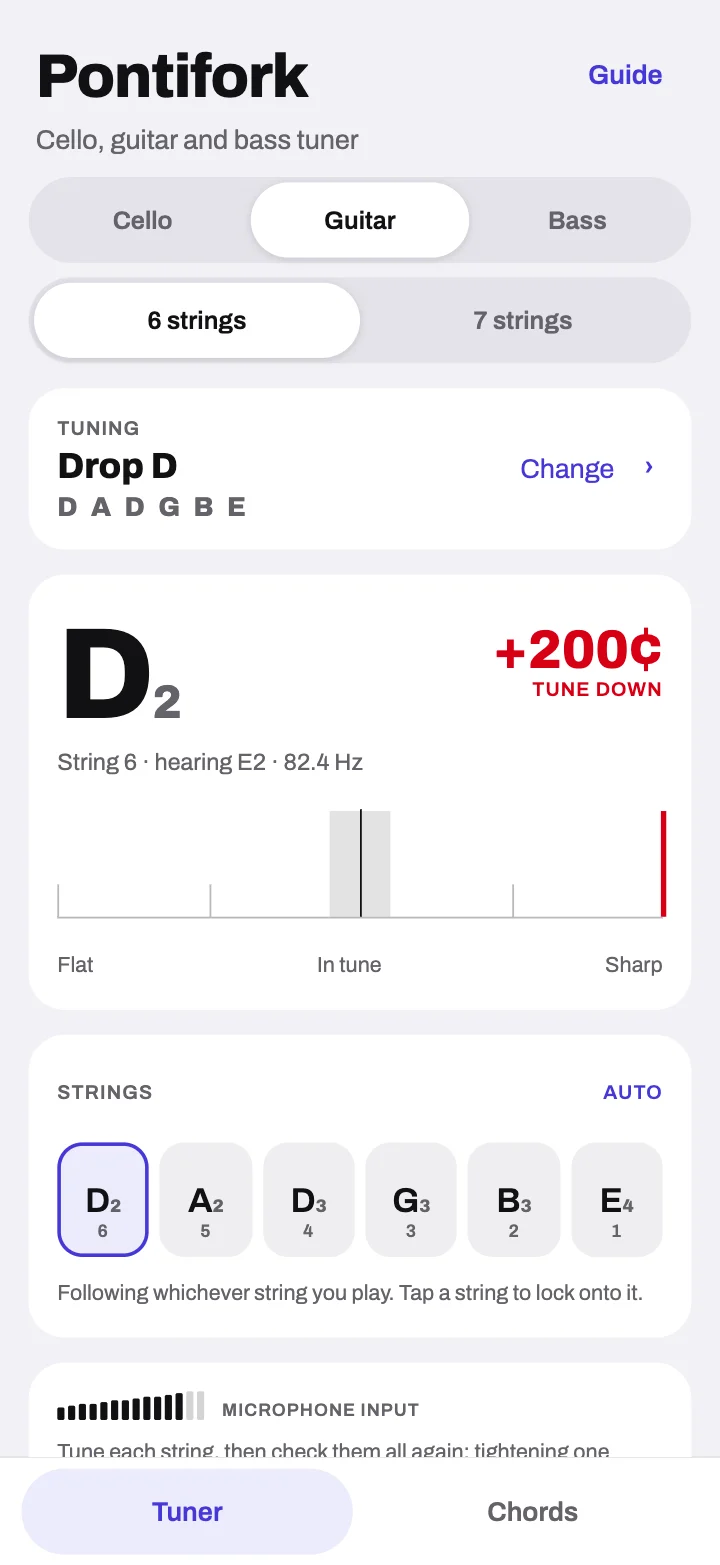
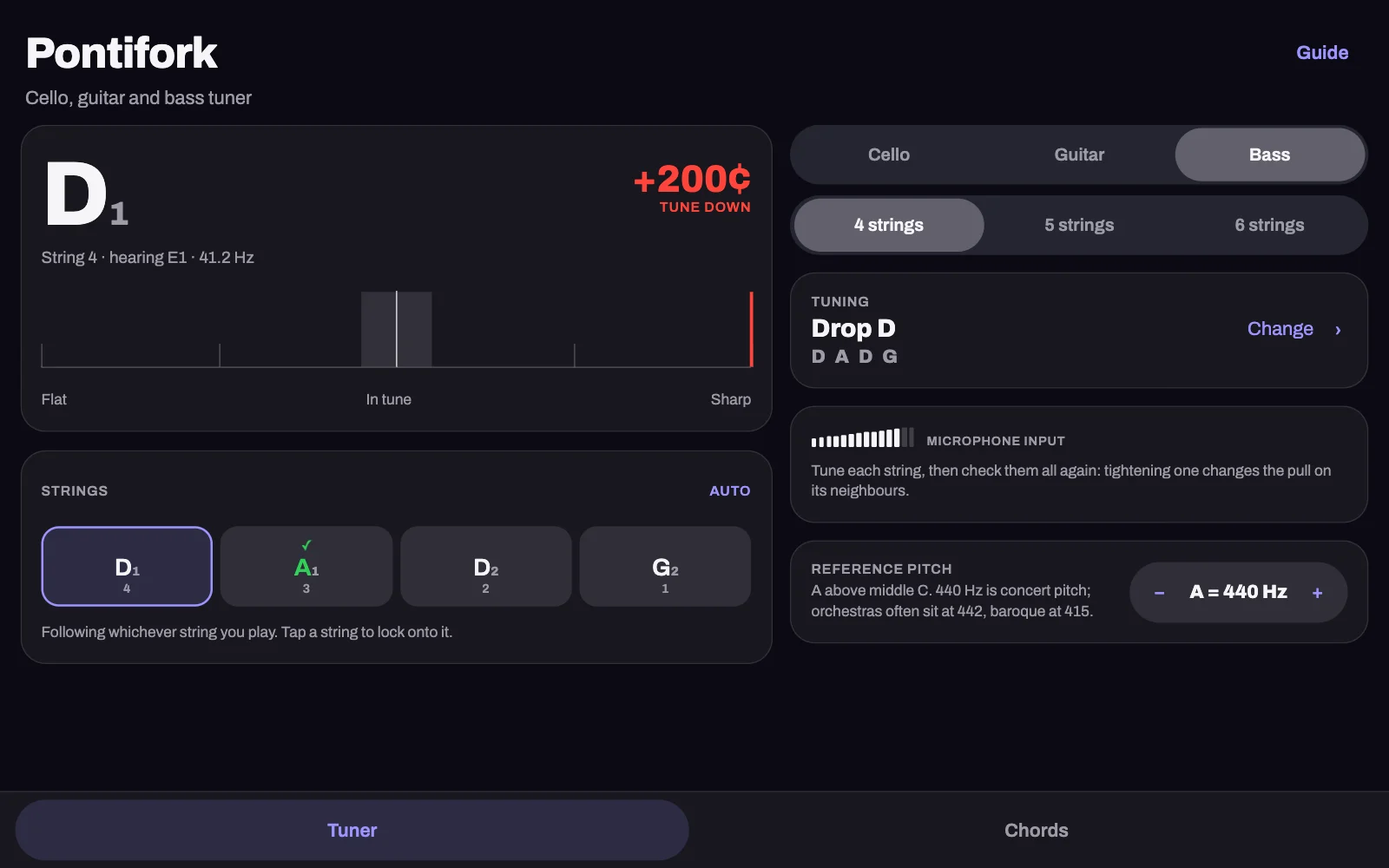
A chromatic tuner says what note you are playing. Pontifork says how far the string is from where your tuning wants it. Switch to drop D and pluck the low E: it reads D2 · hearing E2 · +200¢ · tune down, not “E, in tune”.

Drop D selected while the low string still sounds E: the dial shows D2, hearing E2, plus two hundred cents, Tune down, with the needle pinned to the sharp side.

Every tuning players use

Standard, lowered, drop, open and scordatura

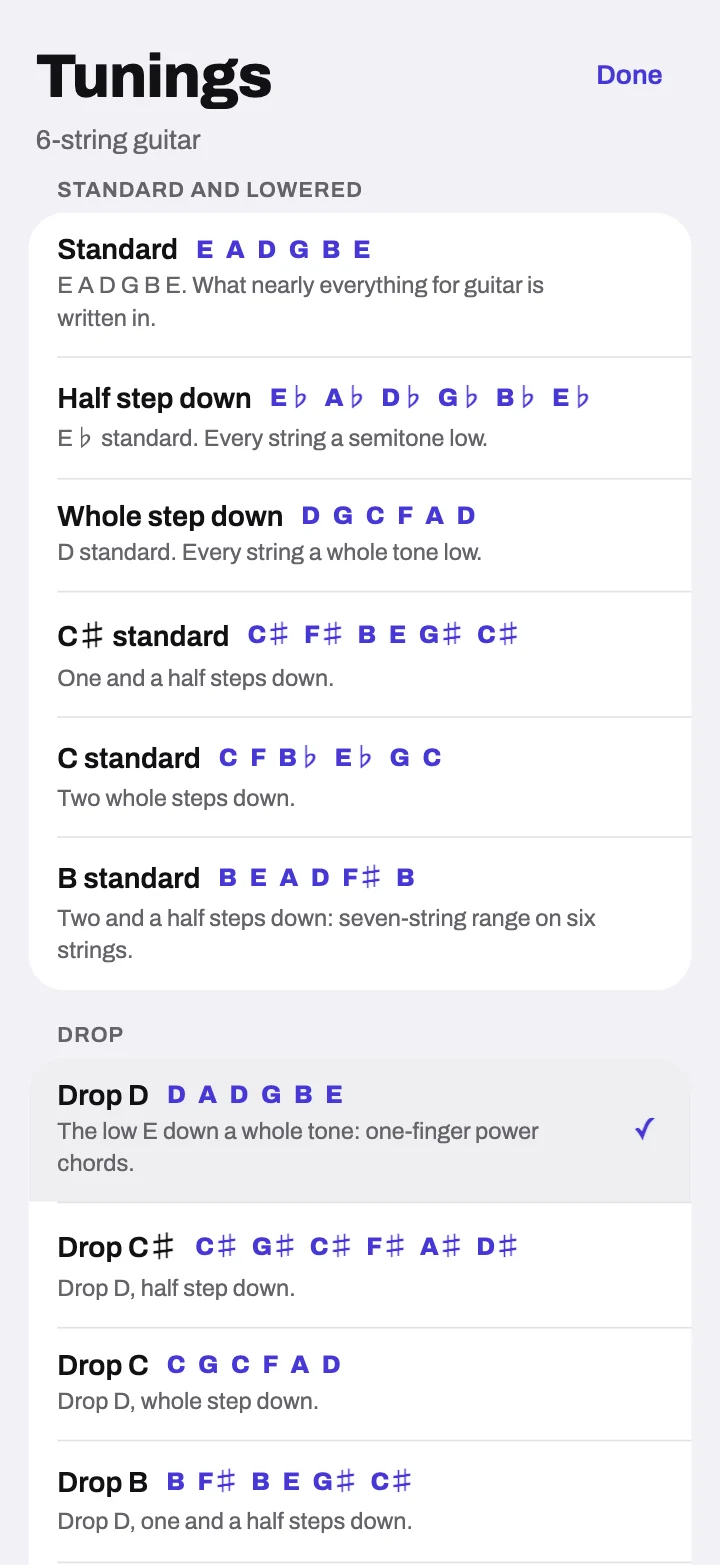
Half and whole step down, C♯ to B standard, every drop from D to A — and to F♯ on seven strings — double drop D, open D, E, G, A and C, DADGAD, QOTSA’s GGDGDD on guitar and bass, bass tenor and high C, and the cello’s scordaturas for Bach and Kodály. Each one shows its open strings before you pick it.

The tuning list for six-string guitar: standard and lowered tunings, then the drop tunings, each with its open-string letters; Drop D is ticked.

Lock a string

Bringing a string a long way

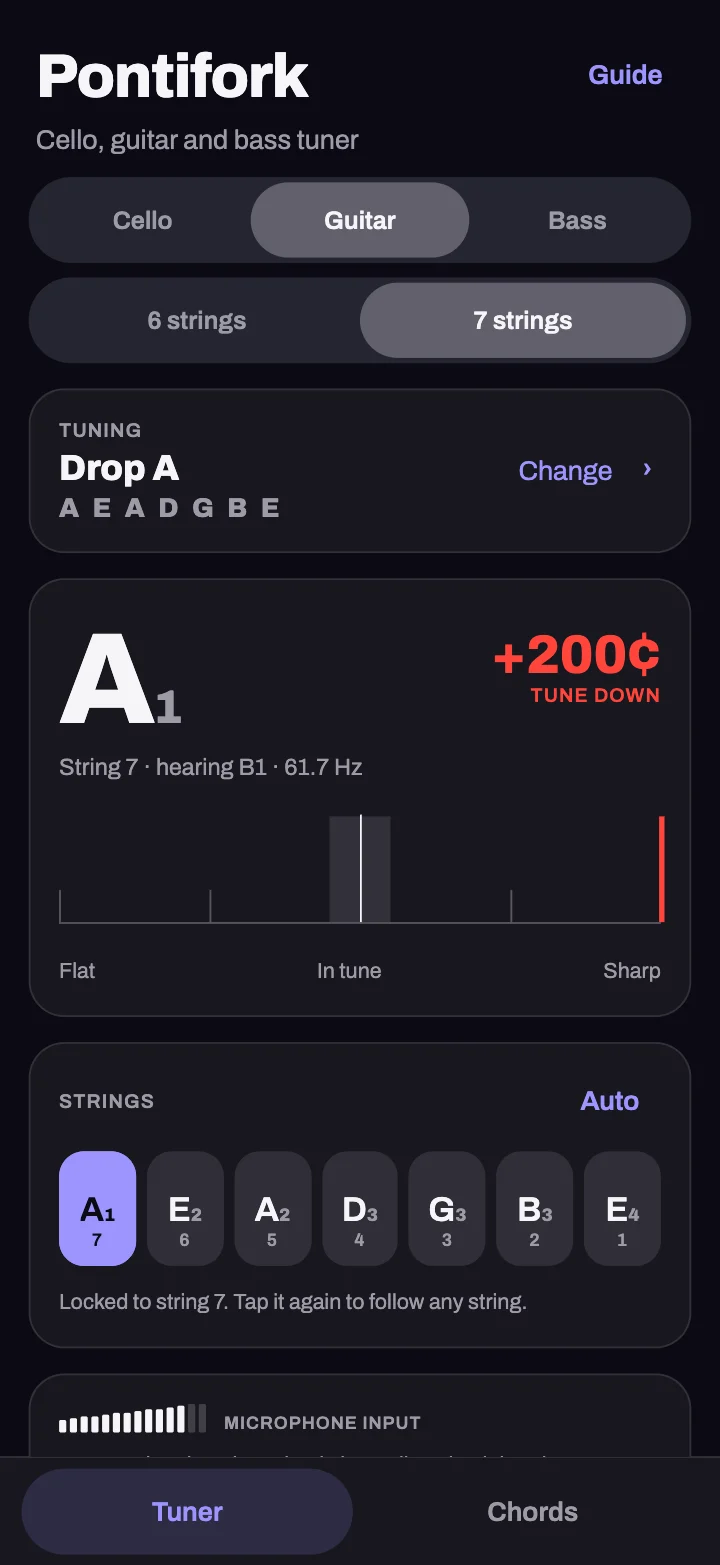
Pontifork follows whichever string you play. When a string is so far off that its neighbour is nearer — dropping a seven-string from B to A, say — tap it, and the tuner stays on that string however far away it starts. Tap it again to go back to following.

Seven-string guitar in drop A, locked to string seven: it still sounds B, so the dial shows A1, hearing B1, plus two hundred cents, Tune down.

Reference pitch

Tune to the room you are playing in

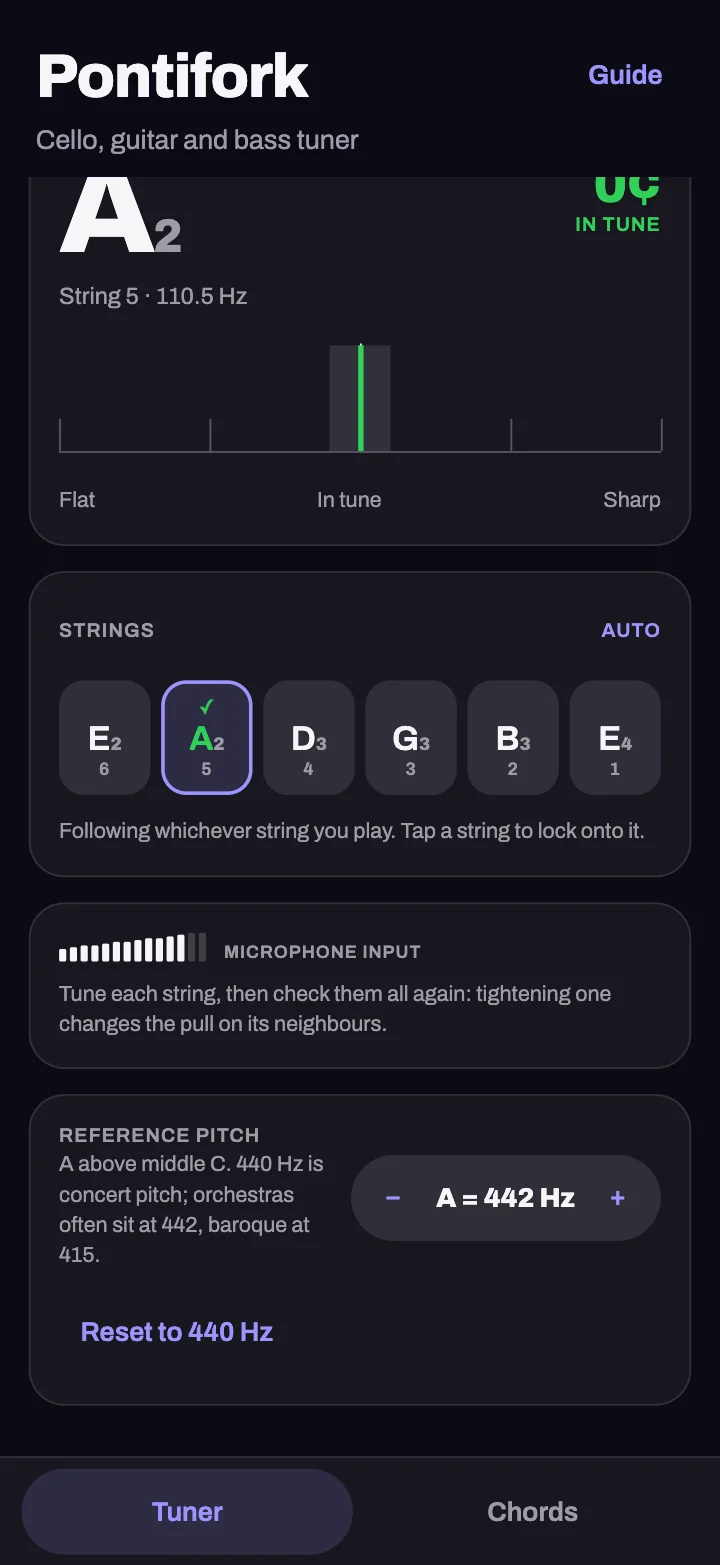
A = 440 Hz is concert pitch, but orchestras often sit at 442, and baroque ensembles at 415. Move the reference a hertz at a time, from 415 to 466, and every string moves with it. It is remembered, along with your instrument and tuning.

The A string in tune against a reference of A equals 442 hertz, with the reference pitch card and its reset button below.

The chord book

Every chord, in the tuning you are in

Twelve roots of ten types (major, minor, 7, m7, maj7, sus2, sus4, 5, dim and aug) for cello, guitar and bass, worked out for the tuning and capo in use.

Shapes follow the tuning

A C shape, half a step down, is a B

The book lists chords by how they sound. Tune half a step down and B’s page shows the C shape you already know, and says so; a whole step down that shape is B♭, and with a capo on the second fret it is D. Drop tunings keep the shapes and fret the low string two higher, or leave it out. Open tunings, DADGAD, QOTSA and the cello’s scordaturas get shapes of their own, found by search.

On guitar each chord has its open shape, where it has one, and the E and A shape barres; a seven-string adds the E shape on its low string. Bass and cello chords are found the same way as Ponticello’s, within one hand’s reach.

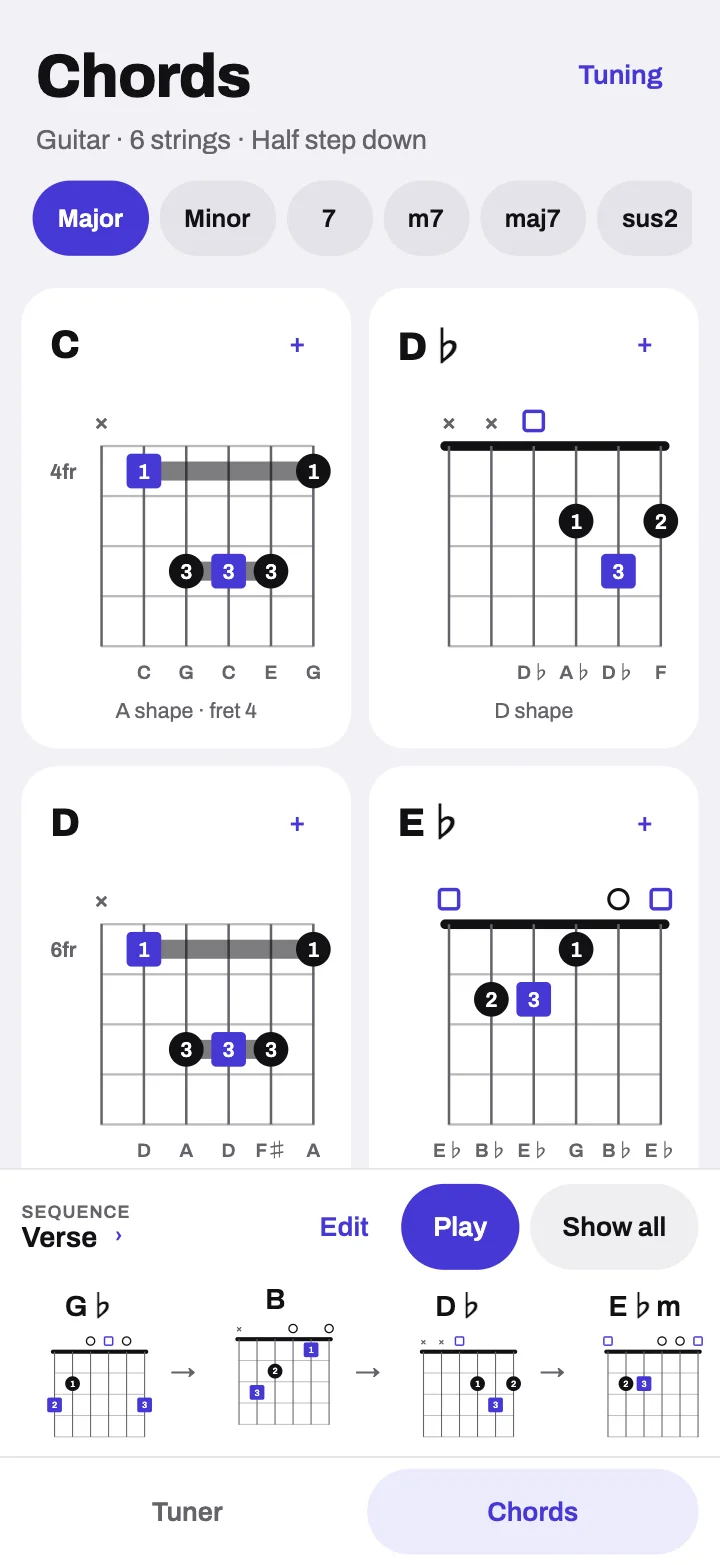
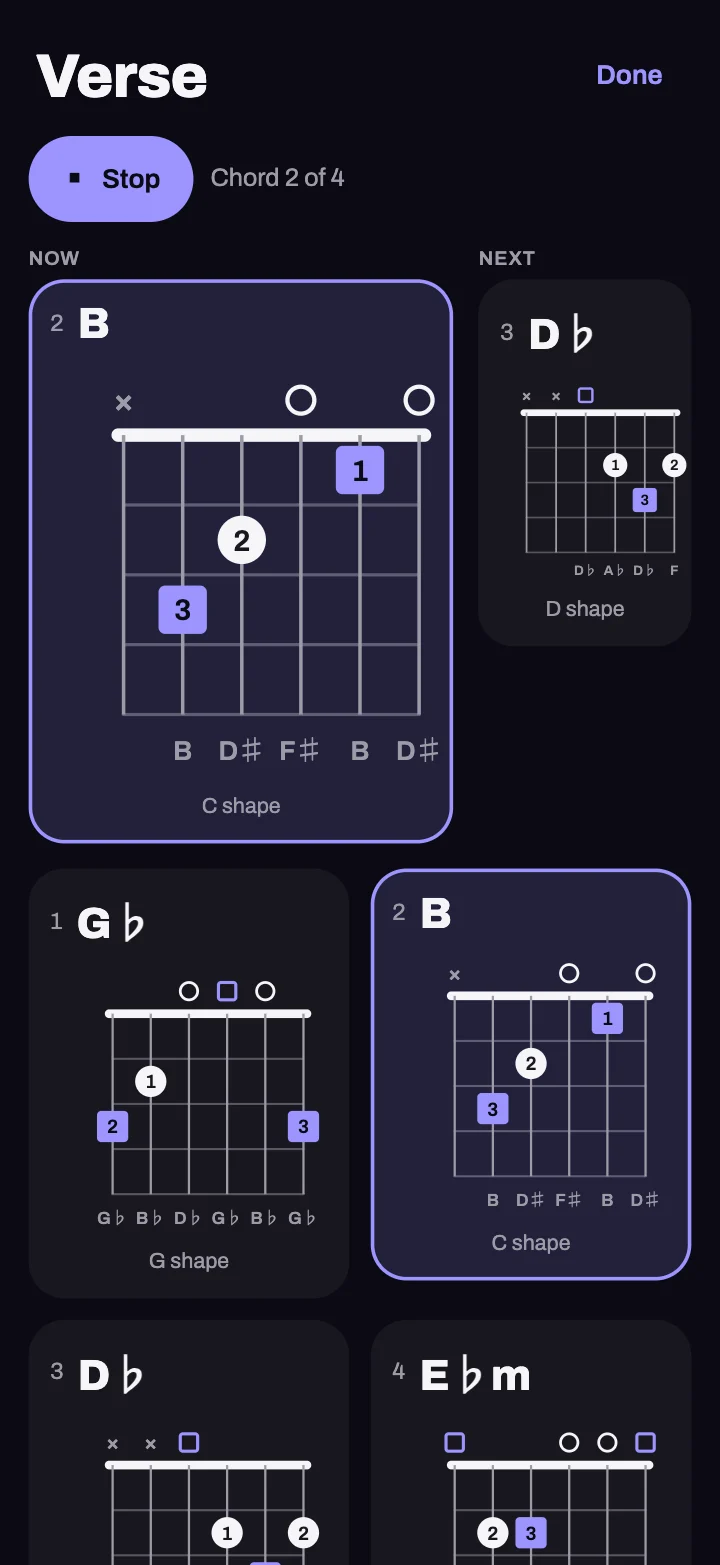
The chord book for guitar a half step down: C as the A shape at fret 4, D flat as the D shape, D as the A shape at fret 6 and E flat as the E shape. Below the grid, a sequence called Verse: G flat, B, D flat and E flat minor.
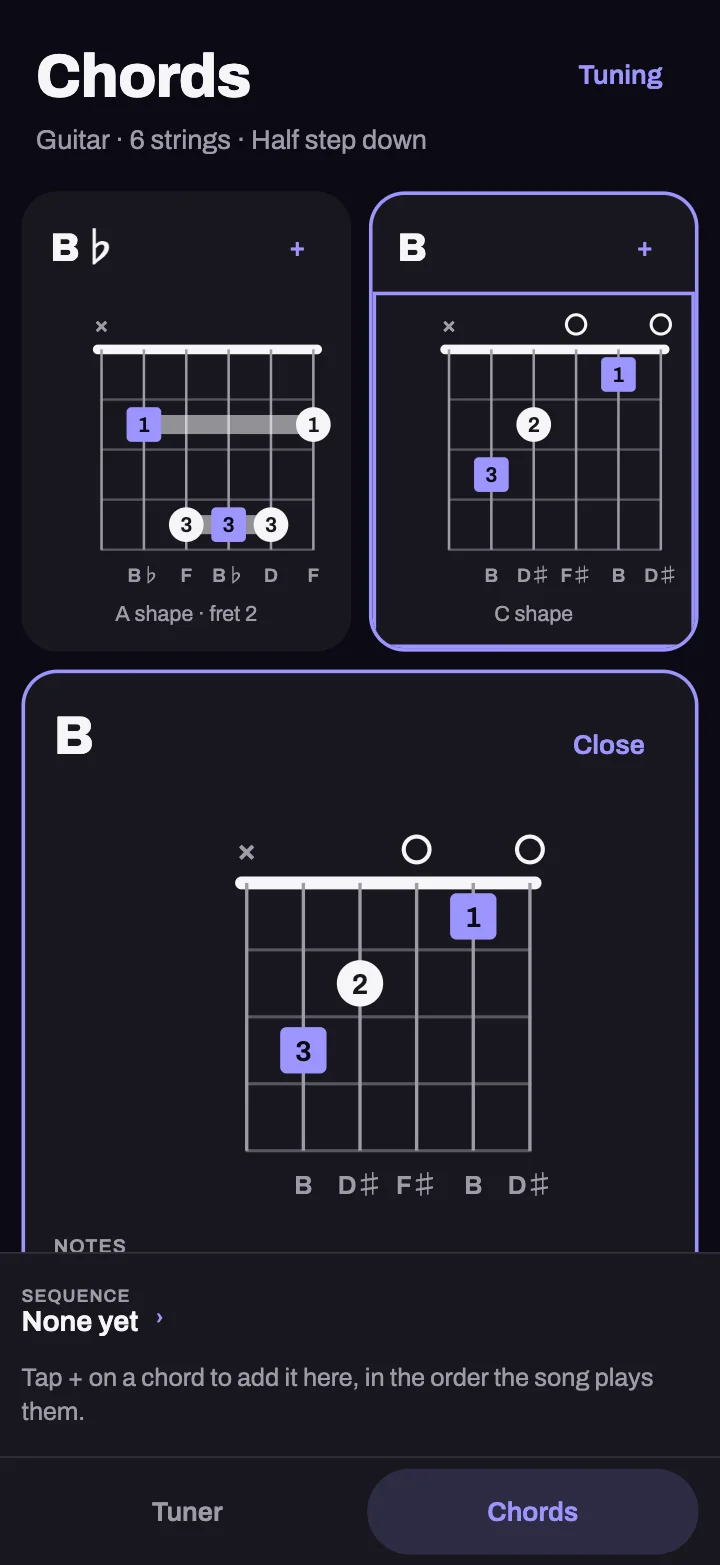
B opened in the dark theme, a half step down: the C shape, its fingers, and the notes B, D sharp, F sharp, B and D sharp under the strings.

Keys

The chords of a key, in degree order

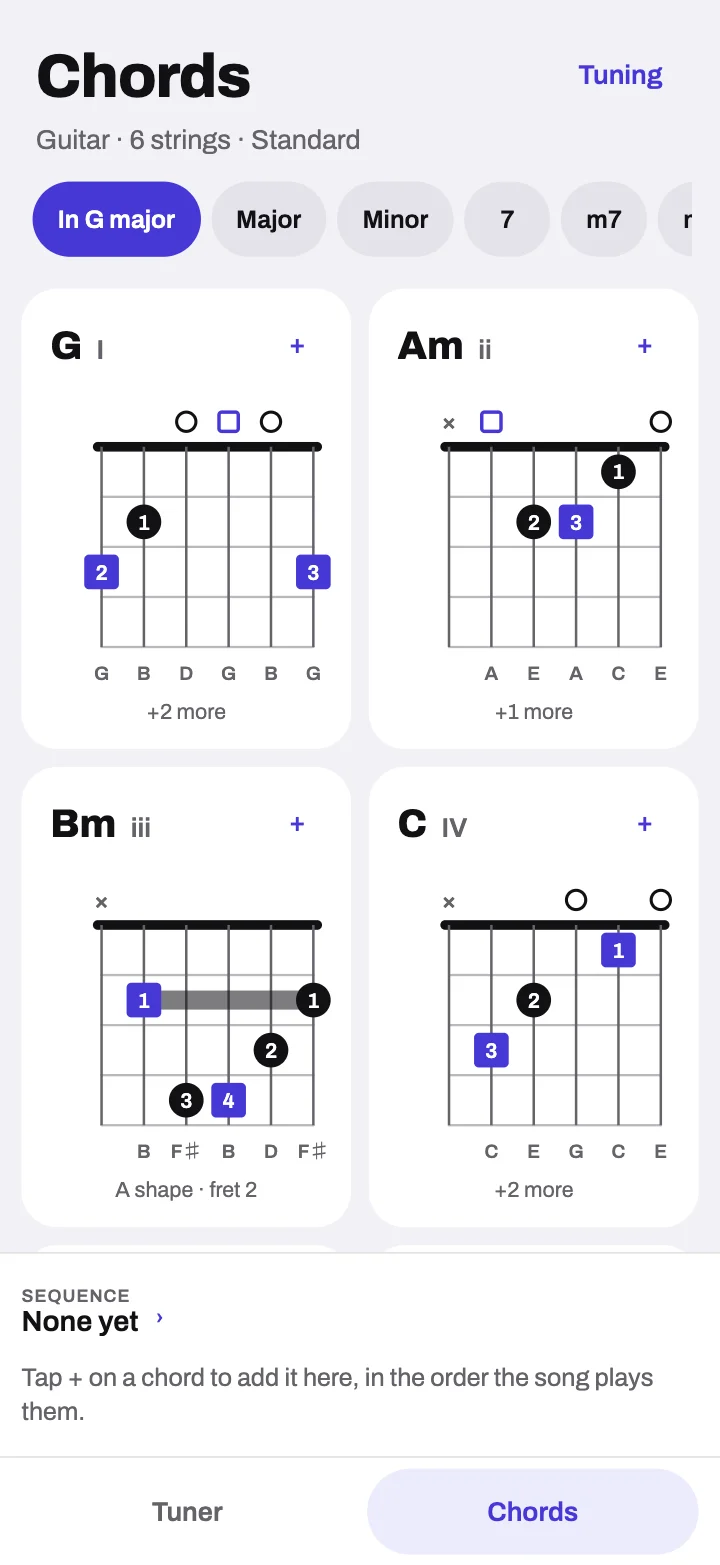
Pick a key and its own page opens: in G major, G, Am, Bm, C, D, Em and F♯dim with their numerals, then the sevenths. Every other page lists the key’s chords first and fades the rest. Minor keys include the major V nearly every song in a minor key uses.

The key of G major: G one, A minor two, B minor three and C four, each with its shape.

Sequences

A song’s chords, in order

Tap + on a chord and it joins the sequence pinned under the book. Keep as many as you like, name them, move and remove chords. Play shows each chord in turn, two seconds apiece, without a sound, so the music is yours. A sequence remembers the tuning it was made in, and offers to switch back to it.

The Verse sequence playing through in the dark theme: B, the C shape, now; D flat, the D shape, next; all four chords below.

How to use it

Tune in six steps

The same on a phone, a tablet or a computer.

  1. Open it and let it listen

    Open the tuner in a browser — or the app — and allow the microphone when asked. On the web, press Enable microphone first: a browser only listens after you ask it to.

  2. Pick your instrument

    Cello, guitar or bass, and for guitar and bass how many strings it has. Pontifork remembers the choice.

  3. Choose a tuning

    Press Change on the tuning card. Tunings are grouped — standard and lowered, drop, open, alternate — each with the notes of its open strings.

  4. Play one string at a time

    Pluck or bow one open string and let it ring. The big letter is the note that string should be; the needle and the number show how far off it is, in cents.

  5. Follow the needle

    Tune up means flat: tighten. Tune down means sharp: loosen. Small turns, then let the string ring again.

  6. Hold it, then check them all

    Hold a string in the green for a moment and it gets a tick. Tightening one string changes the pull on the others, so go round them all once more.

Reading the dial

Green, amber, red

The dial spans half a semitone either way; beyond that the needle waits at the edge and the number keeps counting.

  • In tunewithin 5 cents — the smallest step most ears can hear
  • Closewithin 20 cents — a fine adjustment away
  • Offfurther than that — turn with confidence

The catalogue

Every tuning, lowest string first

Generated from the app’s own catalogue, and checked against it by the test suite.

Cello

Standard and lowered

  • StandardC G D A
  • Half step downB F♯ C♯ G♯

Scordatura

  • Bach Suite No. 5C G D G
  • Kodály Sonata, Op. 8B F♯ D A

Guitar · 6 strings

Standard and lowered

  • StandardE A D G B E
  • Half step downE♭ A♭ D♭ G♭ B♭ E♭
  • Whole step downD G C F A D
  • C♯ standardC♯ F♯ B E G♯ C♯
  • C standardC F B♭ E♭ G C
  • B standardB E A D F♯ B

Drop

  • Drop DD A D G B E
  • Drop C♯C♯ G♯ C♯ F♯ A♯ D♯
  • Drop CC G C F A D
  • Drop BB F♯ B E G♯ C♯
  • Drop A♯ / B♭B♭ F B♭ E♭ G C
  • Drop AA E A D F♯ B
  • Double drop DD A D G B D

Open

  • Open DD A D F♯ A D
  • Open D minorD A D F A D
  • Open EE B E G♯ B E
  • Open GD G D G B D
  • Open AE A E A C♯ E
  • Open CC G C G C E

Alternate

  • DADGADD A D G A D
  • QOTSA (GGDGDD)G G D G D D

Guitar · 7 strings

Standard and lowered

  • StandardB E A D G B E
  • Half step downB♭ E♭ A♭ D♭ G♭ B♭ E♭
  • Whole step downA D G C F A D

Drop

  • Drop AA E A D G B E
  • Drop G♯ / A♭A♭ E♭ A♭ D♭ G♭ B♭ E♭
  • Drop GG D G C F A D
  • Drop F♯F♯ C♯ F♯ B E G♯ C♯

Alternate

  • QOTSA (GGGDGDD)G G G D G D D

Bass · 4 strings

Standard and lowered

  • StandardE A D G
  • Half step downE♭ A♭ D♭ G♭
  • Whole step downD G C F
  • C♯ standardC♯ F♯ B E
  • C standardC F B♭ E♭
  • B standard (BEAD)B E A D

Drop

  • Drop DD A D G
  • Drop C♯C♯ G♯ C♯ F♯
  • Drop CC G C F
  • Drop BB F♯ B E
  • Drop A♯ / B♭B♭ F B♭ E♭
  • Drop AA E A D

Alternate

  • Tenor (ADGC)A D G C
  • QOTSA (GGDG)G G D G

Bass · 5 strings

Standard and lowered

  • StandardB E A D G
  • Half step downB♭ E♭ A♭ D♭ G♭
  • Whole step downA D G C F

Drop

  • Drop AA E A D G

Alternate

  • High C (EADGC)E A D G C
  • QOTSA (DGGDG)D G G D G

Bass · 6 strings

Standard and lowered

  • StandardB E A D G C
  • Half step downB♭ E♭ A♭ D♭ G♭ B
  • Whole step downA D G C F B♭

Drop

  • Drop AA E A D G C

Alternate

  • QOTSA (DGGDGD)D G G D G D

On any device

A tuner in any browser

The web app is the same app — the same engine, the same tunings — on a phone, a tablet or a computer. Add it to your home screen and it opens full screen, like the native one.

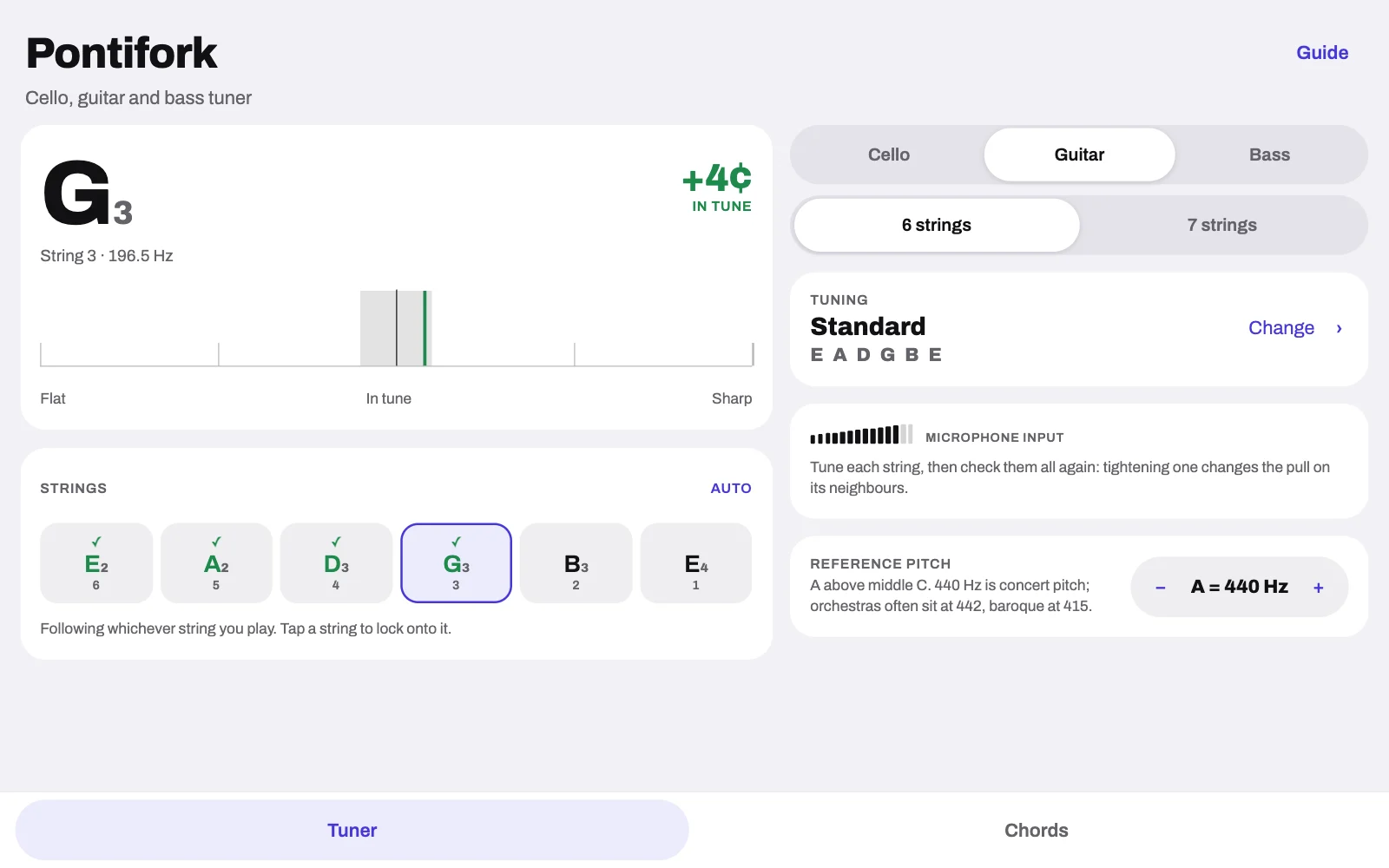
The web app in a wide window: the dial and strings on the left, the instrument, tuning, microphone and reference pitch on the right. The G string is in tune at plus four cents.
Light
The web app in the dark theme, tuning a four-string bass to drop D: the low string still sounds E, plus two hundred cents, Tune down.
Dark — it follows your system

Promises

What it will not do

Free and open source

Build it, fix it, make it yours

Pontifork is built with Expo and React Native for iOS, Android and the web, from Ponticello’s pitch engine. The core — the engine, the string targeting and the tuning catalogue — is pure TypeScript, tested against every open string of every tuning. Add a tuning in one line and the tests check it keeps the promise in its name.

git clone https://github.com/GMBermeo/pontifork
cd pontifork
npm install
npm run web          # the tuner in your browser
npm run ios          # or on a phone
npm run verify       # types, lint, tests